Sunday, October 18, 2026
Back to Home

FreeAgent review UK (2026): 5 Checks for Small Companies

A desk-researched FreeAgent buying guide for UK small companies, with current GBP prices, a worked cost example and checks on filing eligibility.

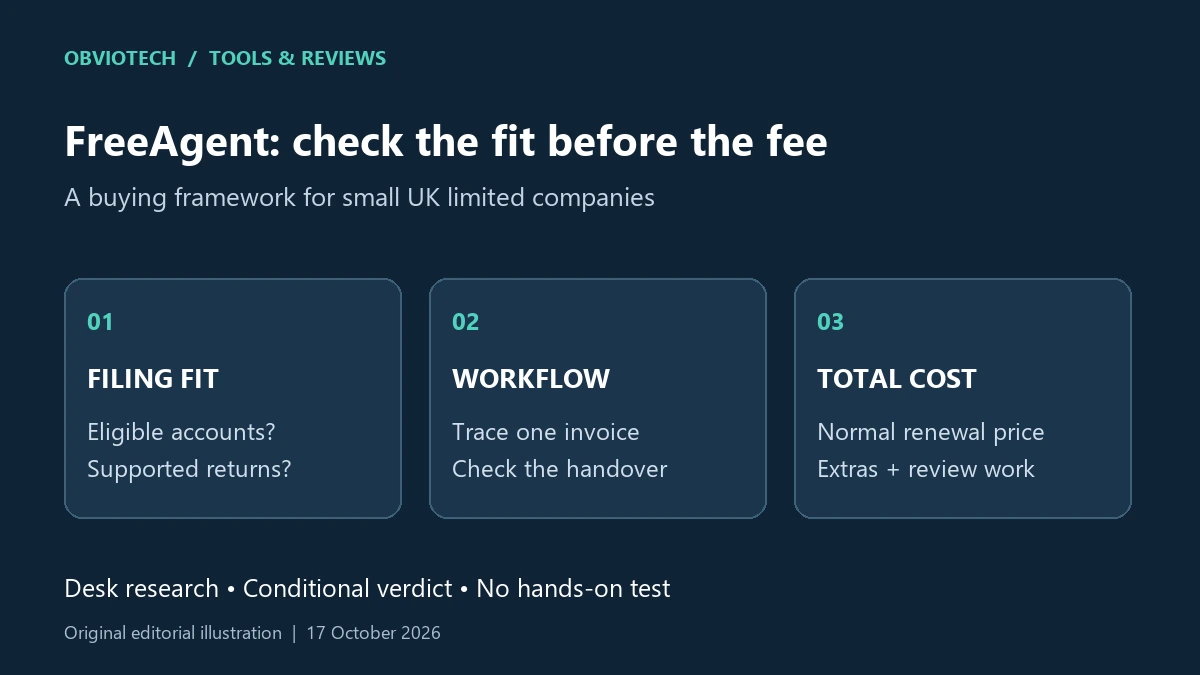
FreeAgent review buying framework: filing fit, invoice workflow and total cost for small UK limited companies

This FreeAgent review helps UK small-company directors check whether the software fits their accounts, filing and budget. The useful question is whether your company qualifies for the supported workflow and what you will pay after introductory offers, rather than whether a headline subscription is free.

By ObvioTech Editorial. Desk research checked 17 October 2026 against supplier documentation and HMRC guidance. We have not tested the software, bank feeds or filing service. Costs below are published prices or clearly labelled arithmetic; there are no affiliate links.

FreeAgent review: Quick Verdict

Shortlist FreeAgent if you run a small UK service company, want bookkeeping and supported year-end filing together, and can confirm your company fits its filing rules. An existing qualifying bank-funded licence can improve the cost case. Neither route establishes that the product handles every return or replaces an accountant.

Look elsewhere, or arrange a separate filing service, if your accounts or tax circumstances fall outside its documented support. A low subscription is poor value if the year-end work must be rebuilt elsewhere. Our recommendation is conditional on that eligibility check and a representative workflow demonstration.

What is FreeAgent?

FreeAgent is cloud accounting software whose published feature overview covers invoices, expenses, bank transactions, project time, reports and tax connections. For a small consultancy, that means the sales record and the bookkeeping can sit in one system rather than separate invoice and spreadsheet files.

The distinction is between a product feature and an observed result. Automatic imports may reduce rekeying, but this research does not measure connection reliability, categorisation accuracy or time saved. Ask the person maintaining your books to demonstrate a correction and reconciliation before deciding that automation will suit your records.

Its end-of-year feature page describes FRS 105 micro-entity accounts and Corporation Tax returns. Those are specific outputs, not a promise to support every limited company. Keep your accountant involved in confirming the accounting standard and reporting requirements before migrating a year of transactions.

FreeAgent Pricing UK

The cost test in this FreeAgent review uses prices checked on 17 October 2026. All figures are GBP excluding VAT; the supplier lists 20% VAT. Business types are separate account choices, not interchangeable upgrades. Promotions can change, so check eligibility and renewal terms before committing.

Account typeRegular monthlyRegular annualIntroductory offer
Limited company£33£330£16.50/month for six months, or £165 for year one
Partnership or LLP£27£270£13.50/month for six months, or £135 for year one
Sole trader£19£190£9.50/month for six months, or £95 for year one
Landlord£10£100£5/month for six months, or £50 for year one
Accountant/bookkeeperClient licence quoteClient licence quotePractice Dashboard is free; client licences are charged
On small screens, scroll the table horizontally.

Optional Smart Capture Unlimited costs £5/month and the Amazon connection £6/month, excluding VAT. Standard capture includes ten receipt or bill files per calendar month. These are optional extras, including for bank-funded users; they should be priced separately from the core licence.

Illustrative twelve-month calculation: a limited company paying monthly under the displayed offer would pay (6 × £16.50) + (6 × £33) = £297. Add twelve months of Smart Capture Unlimited at £5/month and the total becomes £357, excluding VAT. This assumes uninterrupted subscriptions and unchanged terms; it excludes banking, accountant, migration and payment-processing charges.

For the same optional capture add-on, the displayed introductory annual route totals £165 + £60 = £225; the regular annual route totals £330 + £60 = £390. Regular monthly billing totals £396 before add-ons, or £456 with capture. These calculations compare payment routes, not guaranteed future quotes.

Under the bank-funded access conditions, qualifying NatWest, Royal Bank of Scotland and Ulster Bank business current accounts provide the standard software while retained. Mettle eligibility includes at least one transaction a month. Verify the conditions applying to your account; software inclusion does not mean banking or extras are free. Do not move banks solely on the software headline.

Core Features

The practical feature test for this FreeAgent review is a complete job, from invoice to reconciled accounts. The supplier documents project time tracking and invoicing in its accounting overview. Our proposed acceptance exercise is to connect those tasks using representative, sanitised records, rather than judging individual screenshots.

  • Create a sample client invoice and record the associated project time. Check the description, rate and final invoice total.
  • Enter a representative expense, then inspect the extracted amount, date and category. Correct an error rather than assuming capture is accurate.
  • Match the invoice receipt to its bank transaction and explain an unmatched item. Confirm how duplicates and missing transactions will be resolved.
  • Ask your accountant to trace the records into the reports they need. Agree who reviews, corrects and approves the figures before any submission.
  • Request an export and document what it contains. Check whether another person can understand the records without relying on the original operator.

This is a proposed buyer exercise, not a test we performed. Record completion, errors, missing fields and help required. If the everyday user cannot explain the resulting figures, an attractive dashboard is insufficient evidence of a workable handover.

UK Filing: Check Eligibility Before Relying on It

HMRC says the joint online filing service closed on 31 March 2026. Its current filing guidance directs companies towards commercial software for Company Tax Returns, with paper exceptions for a reasonable excuse or filing in Welsh. Companies House accounts still have other filing routes; closure did not make every accounts submission software-only.

The compliance boundary in this FreeAgent review is the supplier’s supported filing scope. Final Accounts use FRS 105 micro-entity reporting, and the software does not determine whether the company qualifies. Companies limited by guarantee are excluded from its Accounts and CT600 filing support. Software availability cannot settle your company’s eligibility.

The same documentation says amended Final Accounts cannot currently be filed through FreeAgent. It also identifies unsupported Corporation Tax scenarios and limits direct payroll filing to monthly submissions, excluding weekly and annual payroll filing. These are reasons to check the exact workflow, rather than reasons to assume the whole product is unsuitable.

For the wider distinction between company returns and a director’s personal obligations, our limited company filing guide provides context. Ask your adviser to confirm any unsupported tax scenario and the fallback filing route before you rely on the product for a deadline.

What We Like / What Could Be Better

The strongest point in this FreeAgent review is the connection between everyday records and documented year-end outputs. That can make procurement simpler for a company whose needs fit the supported scope. Published UK pricing also makes it possible to compare payment routes without converting currencies or treating an introductory offer as the permanent cost.

The limitations matter just as much. Bank-funded access has conditions, automatic capture has an allowance unless you buy an extra, and filing support is narrower than the general phrase “limited company accounting” suggests. None of those limitations measures interface quality; usability and reliability remain untested here.

We would want a prospective buyer to see clearer evidence for their own exceptional transactions before committing. Send the accountant a list of those cases and request a documented response. If a required output needs another product, include that product and the extra handling in the comparison.

Who Is FreeAgent Best For?

For the audience of this FreeAgent review, the strongest shortlist candidate is a small service company with straightforward records, monthly payroll if needed, confirmed filing eligibility and someone accountable for bookkeeping. Bank-funded access is a cost advantage only when the company already meets the relevant conditions and the product fits.

Treat specialist tax circumstances, unsupported filing needs or a different payroll cycle as unresolved purchase questions. A business planning to add complex processes should ask for those future requirements to be demonstrated too. Agree the decision criteria with the accountant and everyday user before comparing headline prices.

Alternatives to Consider

If employee expense control is the main problem, distinguish recording a receipt in accounting software from managing the team’s wider expense process. Our UK expense software guide compares options and plan checks in that adjacent category. A specialist tool may be an additional cost, so include its integration and review work in the budget.

A separate accountant-led filing service is another route when the bookkeeping product suits you but direct submission does not. Obtain a written scope covering the accounts, tax return, corrections and responsibilities. This review did not obtain service quotations, so those costs remain unknown.

Final Verdict + FAQ

Our FreeAgent review supports a shortlist decision, not a universal winner. Confirm filing eligibility first, run the record-to-report exercise second, and compare the full ongoing cost third. Choose it when those checks pass; retain another option when a required output or handover remains unproven.

Is bank-funded access the same as a free business account?

No. The supplier’s licence conditions concern software access; banking charges and optional extras require separate checks. Retaining an eligible account and meeting any transaction condition are part of the software-cost decision.

Can it replace an accountant?

This research does not establish that. FreeAgent’s filing guidance recommends accountant review before submission. Preparing the correct records and applying the right reporting standard remain necessary even when software generates the forms.

What should I compare before switching?

Compare the required outputs, data transfer, user workflow and normal recurring charges. Include the fallback cost for any unsupported filing. Introductory savings are useful only after the product meets the company’s actual requirements.

Next step: use our Xero vs QuickBooks comparison to assemble an alternative accounting shortlist using the same workflow and cost checks.
FreeAgent review UK (2026): 5 Checks for Small Companies

This FreeAgent review helps UK small-company directors check whether the software fits their accounts, filing and budget. The useful question is whether your company qualifies for the supported workflow and what you will pay after introductory offers, rather than whether a headline subscription is free.

By ObvioTech Editorial. Desk research checked 17 October 2026 against supplier documentation and HMRC guidance. We have not tested the software, bank feeds or filing service. Costs below are published prices or clearly labelled arithmetic; there are no affiliate links.

FreeAgent review: Quick Verdict

Shortlist FreeAgent if you run a small UK service company, want bookkeeping and supported year-end filing together, and can confirm your company fits its filing rules. An existing qualifying bank-funded licence can improve the cost case. Neither route establishes that the product handles every return or replaces an accountant.

Look elsewhere, or arrange a separate filing service, if your accounts or tax circumstances fall outside its documented support. A low subscription is poor value if the year-end work must be rebuilt elsewhere. Our recommendation is conditional on that eligibility check and a representative workflow demonstration.

What is FreeAgent?

FreeAgent is cloud accounting software whose published feature overview covers invoices, expenses, bank transactions, project time, reports and tax connections. For a small consultancy, that means the sales record and the bookkeeping can sit in one system rather than separate invoice and spreadsheet files.

The distinction is between a product feature and an observed result. Automatic imports may reduce rekeying, but this research does not measure connection reliability, categorisation accuracy or time saved. Ask the person maintaining your books to demonstrate a correction and reconciliation before deciding that automation will suit your records.

Its end-of-year feature page describes FRS 105 micro-entity accounts and Corporation Tax returns. Those are specific outputs, not a promise to support every limited company. Keep your accountant involved in confirming the accounting standard and reporting requirements before migrating a year of transactions.

FreeAgent Pricing UK

The cost test in this FreeAgent review uses prices checked on 17 October 2026. All figures are GBP excluding VAT; the supplier lists 20% VAT. Business types are separate account choices, not interchangeable upgrades. Promotions can change, so check eligibility and renewal terms before committing.

Account typeRegular monthlyRegular annualIntroductory offer
Limited company£33£330£16.50/month for six months, or £165 for year one
Partnership or LLP£27£270£13.50/month for six months, or £135 for year one
Sole trader£19£190£9.50/month for six months, or £95 for year one
Landlord£10£100£5/month for six months, or £50 for year one
Accountant/bookkeeperClient licence quoteClient licence quotePractice Dashboard is free; client licences are charged
On small screens, scroll the table horizontally.

Optional Smart Capture Unlimited costs £5/month and the Amazon connection £6/month, excluding VAT. Standard capture includes ten receipt or bill files per calendar month. These are optional extras, including for bank-funded users; they should be priced separately from the core licence.

Illustrative twelve-month calculation: a limited company paying monthly under the displayed offer would pay (6 × £16.50) + (6 × £33) = £297. Add twelve months of Smart Capture Unlimited at £5/month and the total becomes £357, excluding VAT. This assumes uninterrupted subscriptions and unchanged terms; it excludes banking, accountant, migration and payment-processing charges.

For the same optional capture add-on, the displayed introductory annual route totals £165 + £60 = £225; the regular annual route totals £330 + £60 = £390. Regular monthly billing totals £396 before add-ons, or £456 with capture. These calculations compare payment routes, not guaranteed future quotes.

Under the bank-funded access conditions, qualifying NatWest, Royal Bank of Scotland and Ulster Bank business current accounts provide the standard software while retained. Mettle eligibility includes at least one transaction a month. Verify the conditions applying to your account; software inclusion does not mean banking or extras are free. Do not move banks solely on the software headline.

Core Features

The practical feature test for this FreeAgent review is a complete job, from invoice to reconciled accounts. The supplier documents project time tracking and invoicing in its accounting overview. Our proposed acceptance exercise is to connect those tasks using representative, sanitised records, rather than judging individual screenshots.

  • Create a sample client invoice and record the associated project time. Check the description, rate and final invoice total.
  • Enter a representative expense, then inspect the extracted amount, date and category. Correct an error rather than assuming capture is accurate.
  • Match the invoice receipt to its bank transaction and explain an unmatched item. Confirm how duplicates and missing transactions will be resolved.
  • Ask your accountant to trace the records into the reports they need. Agree who reviews, corrects and approves the figures before any submission.
  • Request an export and document what it contains. Check whether another person can understand the records without relying on the original operator.

This is a proposed buyer exercise, not a test we performed. Record completion, errors, missing fields and help required. If the everyday user cannot explain the resulting figures, an attractive dashboard is insufficient evidence of a workable handover.

UK Filing: Check Eligibility Before Relying on It

HMRC says the joint online filing service closed on 31 March 2026. Its current filing guidance directs companies towards commercial software for Company Tax Returns, with paper exceptions for a reasonable excuse or filing in Welsh. Companies House accounts still have other filing routes; closure did not make every accounts submission software-only.

The compliance boundary in this FreeAgent review is the supplier’s supported filing scope. Final Accounts use FRS 105 micro-entity reporting, and the software does not determine whether the company qualifies. Companies limited by guarantee are excluded from its Accounts and CT600 filing support. Software availability cannot settle your company’s eligibility.

The same documentation says amended Final Accounts cannot currently be filed through FreeAgent. It also identifies unsupported Corporation Tax scenarios and limits direct payroll filing to monthly submissions, excluding weekly and annual payroll filing. These are reasons to check the exact workflow, rather than reasons to assume the whole product is unsuitable.

For the wider distinction between company returns and a director’s personal obligations, our limited company filing guide provides context. Ask your adviser to confirm any unsupported tax scenario and the fallback filing route before you rely on the product for a deadline.

What We Like / What Could Be Better

The strongest point in this FreeAgent review is the connection between everyday records and documented year-end outputs. That can make procurement simpler for a company whose needs fit the supported scope. Published UK pricing also makes it possible to compare payment routes without converting currencies or treating an introductory offer as the permanent cost.

The limitations matter just as much. Bank-funded access has conditions, automatic capture has an allowance unless you buy an extra, and filing support is narrower than the general phrase “limited company accounting” suggests. None of those limitations measures interface quality; usability and reliability remain untested here.

We would want a prospective buyer to see clearer evidence for their own exceptional transactions before committing. Send the accountant a list of those cases and request a documented response. If a required output needs another product, include that product and the extra handling in the comparison.

Who Is FreeAgent Best For?

For the audience of this FreeAgent review, the strongest shortlist candidate is a small service company with straightforward records, monthly payroll if needed, confirmed filing eligibility and someone accountable for bookkeeping. Bank-funded access is a cost advantage only when the company already meets the relevant conditions and the product fits.

Treat specialist tax circumstances, unsupported filing needs or a different payroll cycle as unresolved purchase questions. A business planning to add complex processes should ask for those future requirements to be demonstrated too. Agree the decision criteria with the accountant and everyday user before comparing headline prices.

Alternatives to Consider

If employee expense control is the main problem, distinguish recording a receipt in accounting software from managing the team’s wider expense process. Our UK expense software guide compares options and plan checks in that adjacent category. A specialist tool may be an additional cost, so include its integration and review work in the budget.

A separate accountant-led filing service is another route when the bookkeeping product suits you but direct submission does not. Obtain a written scope covering the accounts, tax return, corrections and responsibilities. This review did not obtain service quotations, so those costs remain unknown.

Final Verdict + FAQ

Our FreeAgent review supports a shortlist decision, not a universal winner. Confirm filing eligibility first, run the record-to-report exercise second, and compare the full ongoing cost third. Choose it when those checks pass; retain another option when a required output or handover remains unproven.

Is bank-funded access the same as a free business account?

No. The supplier’s licence conditions concern software access; banking charges and optional extras require separate checks. Retaining an eligible account and meeting any transaction condition are part of the software-cost decision.

Can it replace an accountant?

This research does not establish that. FreeAgent’s filing guidance recommends accountant review before submission. Preparing the correct records and applying the right reporting standard remain necessary even when software generates the forms.

What should I compare before switching?

Compare the required outputs, data transfer, user workflow and normal recurring charges. Include the fallback cost for any unsupported filing. Introductory savings are useful only after the product meets the company’s actual requirements.

Next step: use our Xero vs QuickBooks comparison to assemble an alternative accounting shortlist using the same workflow and cost checks.