A cloud exit plan connects supplier choice with the practical ability to recover data and move operations. UK government, NHS and NCSC guidance address different parts of that problem. Read together, they give business buyers a useful distinction: a service can be valuable and secure while still being difficult to leave.
Desk research by ObvioTech Editorial, checked on 12 October 2026. This analysis is not a hands-on vendor review and contains no affiliate links.
Table of Contents
Signal Summary
Government guidance recognises that accepting some supplier dependence can be worthwhile. NHS guidance calls for exit plans to undergo an initial dry run or test exercise. NCSC guidance covers both cloud security and recoverable backups. These documents have different audiences and purposes; none of the public-sector guidance cited here creates a blanket procurement requirement for private UK SMEs.
Why This Is Structurally Significant
The government’s technical lock-in guidance describes a trade-off. Managed services can reduce complexity and operational work, but moving away may require substantial engineering effort. The guidance treats value and portability as factors to balance, rather than demanding the elimination of all dependencies.
The same document identifies skills as another source of dependence. A team familiar with one provider can find it easier to continue using that provider. The resulting constraint is not limited to a contract or export format: it can include the knowledge needed to operate a replacement.
What Drove This
The NHS cloud exit strategy describes several migration difficulties: data transfer, changes in functionality, staff training and downstream integrations. It also notes that some application information, including access-control metadata, may not translate meaningfully into a different system.
That guidance explicitly recognises the value of cloud services. Its discussion of exit planning is not a claim that outsourcing is inherently unreliable. It concerns how to make a controlled move when requirements or circumstances change, including preparations for continuity and rollback.
Implications for UK Businesses
The NCSC cloud security principles address provider selection and security configuration. They include resilience, identity and audit information. Their scope is different from a migration exercise: selecting suitable security controls does not, by itself, demonstrate that an application can be replaced.
NCSC advice on backing up critical data says organisations need to know how to access and restore their backups. It cautions against relying solely on mechanisms within an online service for a reliable backup of important information.
These source documents cover separate questions: the value of a dependency, the steps needed to leave it, the security of the running service and the recovery of critical information. Their recommendations should be read within their stated contexts, particularly where NHS or government requirements are involved.
What to Watch Next
The government guidance describes continuing assessment after procurement, including changes in value, switching costs and preparedness. The NHS cloud exit plan guidance identifies functionality, data movement and continuity as parts of an exit plan. These provide documented areas to revisit when the service, its integrations or the organisation’s needs change.
Our related analysis of AI supplier concentration considers the broader dependency question. It is internal editorial context, not a substitute for the primary guidance linked here.
ObvioTech Assessment: a Cloud Exit Plan Needs Evidence
Our assessment is that UK SMEs should buy an acceptable dependency, then keep evidence that it remains acceptable. Removing every provider-specific feature can sacrifice useful functionality. Accepting every dependency without examining recovery creates a different weakness. A proportionate exercise helps a buyer distinguish those choices.
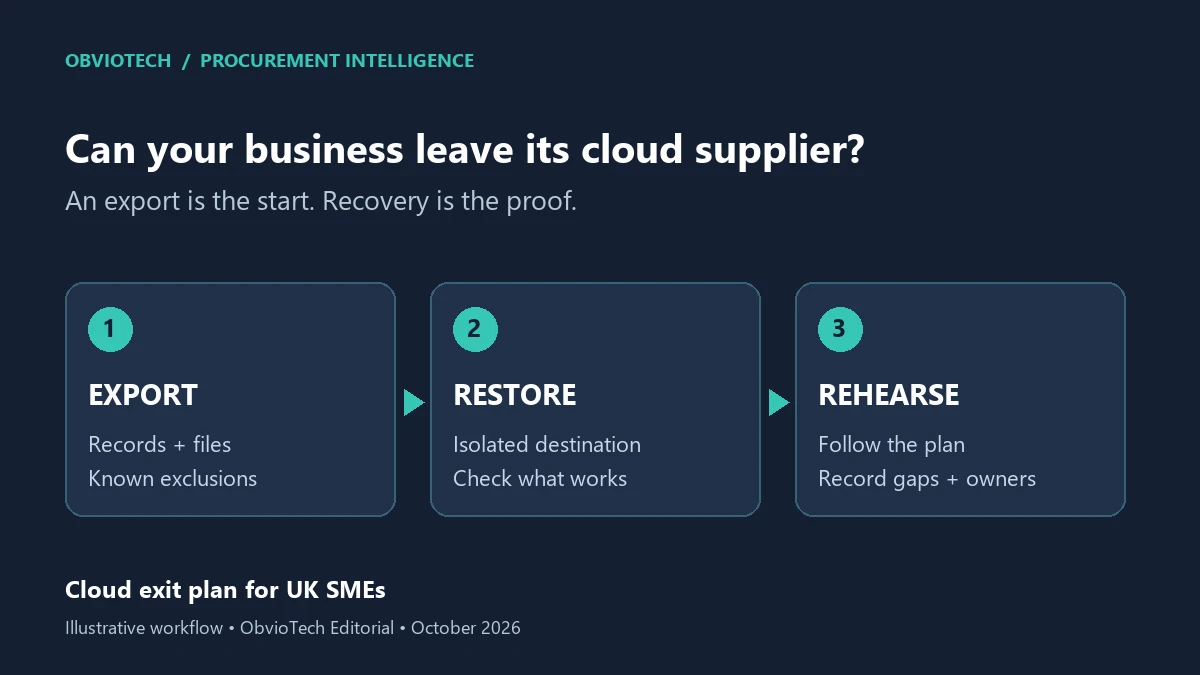
For the next renewal, we recommend five checks. First, ground the cloud exit plan in one business process that must continue and name its accountable owner. List the application, identity service, integrations and external support on which it depends. This keeps the discussion tied to actual operations rather than subscription counts.
Second, obtain a permitted sample export and document what it includes. Check attachments, identifiers, dates and relationships between records. For example, a professional-services firm may need both client documents and the project records linking them. This is an illustrative scenario, not a reported customer case or a finding about a particular supplier.
Third, restore that sample in an isolated destination while production continues normally. Use sanitised records where practical and protect confidential information. Count important record types, open representative attachments and compare their meaning with the source. A matching file checksum establishes copying integrity; it does not establish that an application has recovered its functionality.
Fourth, ask a colleague who did not write the instructions to follow them. Record delays, missing steps and points requiring supplier help. Our proposed exercise is intentionally small: its purpose is to find gaps before a real interruption, not to claim complete disaster-recovery certification.
Fifth, record verified exit charges, expected staff effort and unresolved questions separately. Do not fill unknown costs with optimistic estimates. Keep the exit strategy and its evidence somewhere secure that remains accessible if the original service is unavailable.
Use the findings to choose between staying, staying while closing specific gaps, or preparing a controlled migration. A failed rehearsal can be useful if it exposes a fixable problem. An untested assertion that the business can leave at any time gives the buyer much less information.
Sources
Primary references: UK Government Digital Service, Managing technical lock-in in the cloud; NHS England Digital, NHS cloud exit strategy; NCSC, The cloud security principles; and NCSC, Back up your organisation’s critical data. Each is linked at its first substantive use above. Recommendations in the ObvioTech Assessment are our analysis, not quoted requirements from these organisations.