Signal Summary
Open banking payments are acquiring commercial scheme rules alongside their technical standards. The FCA recognised the UK Payments Initiative scheme launch in June 2026. UKPI says its model combines a shared rulebook, commercial arrangements and operational standards for recurring account-to-account payments. Its September update describes initial use cases and continuing work on wider retail protections. Separately, the FCA’s design for a future standards body distinguishes common interfaces from competing commercial schemes. These are different functions. The regulator’s January pricing statement also describes a temporary enforcement position, rather than a permanent settlement. This article examines those published arrangements and their limits.
Why This Is Structurally Significant
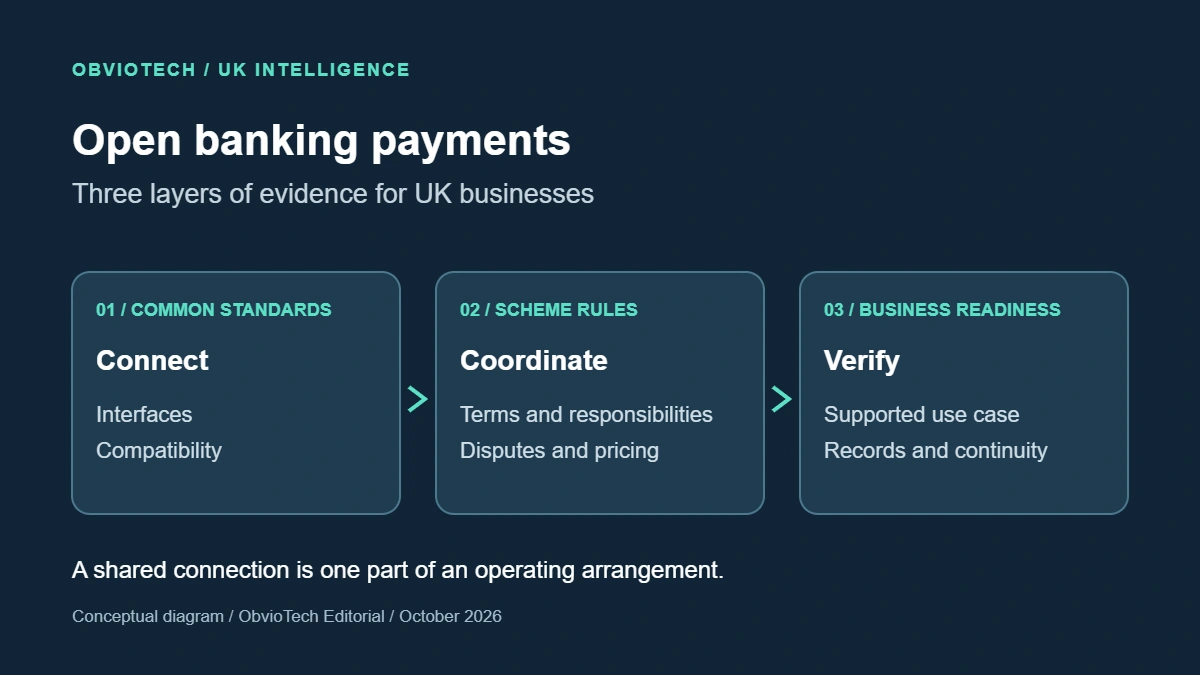
In FS25/4, the FCA assigns common technical standards, interface performance monitoring and directory services to its proposed Future Entity. An application programming interface, or API, is the connection through which separate software systems exchange information. The proposed body would support compatibility across services, subject to legislation.
For open banking payments, the same design places commercial schemes in a separate, competitive layer. Those schemes set rules for participant relationships and resolving problems. Their agreements cover matters including disputes, costs and API standards. The FCA expects commercial operators to use common standards while retaining room to develop services beyond them. A shared interface and a shared commercial agreement therefore occupy distinct places in the published architecture.
What Drove This
The FCA’s 2 June statement welcomed UKPI’s first scheme and called for competition between commercial schemes for these account-to-account services. The announcement concerns recurring goods and services, extending the policy discussion beyond individual payment instructions.
UKPI’s launch announcement says customers authorise collections within agreed limits, including how much is collected and how long permission lasts. It reports a finalised participant rulebook and market rollout following live proving. These are the operator’s statements about its own scheme; they are not tests conducted by ObvioTech.
Commercial coordination of open banking payments also has a competition-law dimension. In its 20 January statement, the FCA said it and the Payment Systems Regulator would not then prioritise a Competition Act investigation into UKPI’s centralised access-fee pricing model. That is a stated enforcement priority, not an unconditional approval of every future pricing arrangement.
Implications for UK Businesses
UKPI’s 11 September update identifies regulated financial services, utilities, rail journeys, government payments and charity donations within its initial scope. It says participants have been onboarding while technical requirements and reporting are refined. It also describes work with merchants, participants and regulators on purchase protection, disputes and pricing for more complex retail environments.
The operator explicitly distinguishes that work from its earlier scope. Goods disputes, fulfilment failures, billing errors, fraud and insolvency appear among the risks it lists for broader commerce. Its current rollout page describes two waves, with wider business use following the initial controlled rollout. It links the second wave to industry readiness and regulatory guidance, without stating a fixed launch date. The pages do not establish that open banking payments are available to every UK merchant or bank account.
What to Watch Next
The FCA’s June statement said it would consult on a long-term regulatory framework by the end of 2026, subject to legislation granting new powers. That remains a dated commitment in that source, rather than evidence here that a consultation or legislation has been completed. Its May assessment publication separately records work on establishing a future standards-setting body.
The January pricing statement specifies another milestone: the temporary position lasts until the anticipated framework is in place or July 2027, whichever comes first. It also allows the authorities to reconsider their priorities when circumstances change. UKPI’s published next-stage work identifies additional observable developments: participant expansion and the definition of retail purchase protection, dispute processes and pricing.
ObvioTech Assessment
ObvioTech opinion: open banking payments should be assessed as an operating arrangement, not simply an available API. The structural advance is the combination of common connections with rules for the relationships using them. That makes the commercial scheme a central part of integration due diligence. A launch announcement alone is an inadequate basis for changing a business-critical collection process.
Our proposed readiness checklist has five parts. First, establish the exact supported use case, participating banks and account types for the intended customer journey. Keep a dated answer from the contracting provider. A scheme participant list is useful context, but we would not treat it as proof that every participant offers the same service to every customer.
Second, examine consent limits and cancellation. The evidence should explain what happens when a charge exceeds an agreed limit or permission ends. Third, map exception ownership: who investigates a failed collection, handles a refund or responds to a disputed purchase. We recommend recording responsibilities and response expectations before accepting a generic assurance about protection.
Fourth, compare the full commercial terms, including implementation work and exception handling, without assuming that account-to-account automatically means cheaper overall. Fifth, rehearse reconciliation and continuity. An illustrative subscription business should distinguish a cancelled mandate from an unpaid invoice and an unfulfilled service. Those events require different records and decisions. This is a suggested exercise, not a measured customer result.
The useful decision is whether a bounded collection journey has enough evidence to proceed, needs specific gaps closed, or should wait. We favour limited, reversible adoption where that evidence exists. Wider rollout should follow demonstrated operational readiness. Our cloud dependency analysis provides related continuity context; it does not establish payment-scheme protections.
Sources
Desk research by ObvioTech Editorial, checked on 15 October 2026. Primary sources are linked at their substantive use: FCA FS25/4 (8 August 2025; system update 3 December), scheme-launch statement (2 June 2026), pricing statement (20 January) and standards-body assessment publication (1 May); UKPI’s launch (2 June), firsthand operator update (11 September) and current cVRP rollout page (undated). Operator claims are attributed. No supplier recommendation, hands-on trial, cost saving or universal protection is asserted.