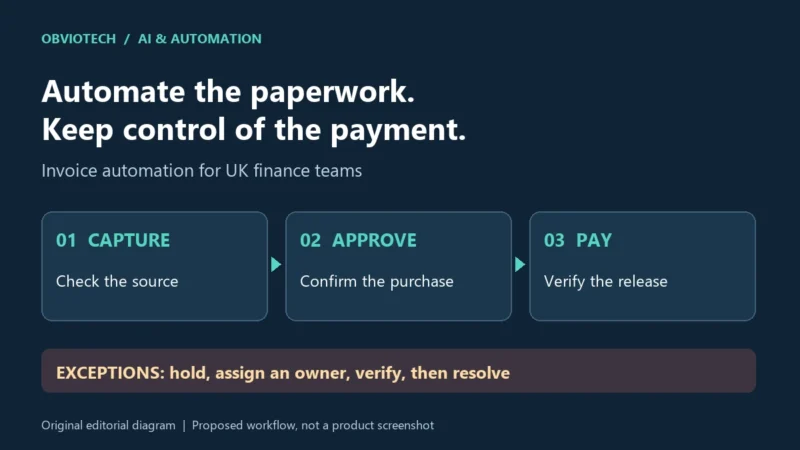
Editorial correction — 14 October 2026: We corrected credit/task billing and Make region availability, removed stale currency conversions and untested winners, and qualified data-protection claims. Recommendations now depend on a documented workflow trial.
ObvioTech may earn a referral fee if you sign up through links on this page. This is a comparison of published specifications and buying considerations; no controlled cost, uptime or usability benchmark was performed.
If you run a UK business and you’re still copy-pasting data between apps, manually chasing approvals, or asking your team to do work that a computer could handle in seconds — you already know you need an automation platform. For most, the shortlist comes down to two platforms: Make.com vs Zapier UK — and the choice is not as obvious as it first appears.
This Make.com vs Zapier UK guide compares billing units, workflow features and data-handling questions. Prices and supported actions change; check the exact configuration before purchase.
For context, our analysis of AI in business operations discusses the wider operational questions. Automation should have a named owner and a recovery procedure.
Table of Contents
What Are Make.com and Zapier — and Why Does This Choice Matter?
Zapier connects applications through trigger-and-action workflows called Zaps. Its catalogue is large, but catalogue size alone does not establish that the particular action, field or account edition you need is supported.
Make uses visual scenarios built from modules. Both products support conditional workflows. Compare a representative process rather than assuming that only Make can handle complex logic.
For a UK buyer, the practical questions are the full subscription and usage cost, who can maintain the workflow, and where each connected service processes data.
A mismatch can create unnecessary cost or maintenance work. Use a representative trial to assess the workflow before committing.
Pricing: What UK Businesses Actually Pay in 2026
Use the currency and billing period shown at checkout. Convert any foreign-currency quote using your payment provider’s rate and add applicable tax and fees. A fixed 20–25% “UK premium” is not supported.
Zapier billing checks
| Item | Check before subscribing |
|---|---|
| Plan and billing term | Monthly versus annual commitment; normal renewal price |
| Usage | Included tasks, overage setting and pause limits |
| Features | Required apps, multi-step workflows, collaboration and support |
| UK total | Checkout currency, tax treatment and payment conversion charges |
The old converted price estimates have been removed because they did not establish a current checkout price or billing term.
Zapier normally counts successful actions, not the trigger. One trigger followed by two ordinary successful actions generally uses two tasks, not three. Some specialised actions use different units. Read the task rules and measure the actual workflow.
You can verify current Zapier plan pricing directly on the Zapier pricing page.
Make billing checks
| Item | Check before subscribing |
|---|---|
| Billing unit | Credits, including any variable AI usage |
| Allowance | Selected credit tier and extra-credit settings |
| Features | Required modules, team access and support |
| UK total | Normal renewal price, billing term, currency and tax |
Compare the same monthly workload on both platforms. Credits and Zapier tasks are not interchangeable units.
Make bills in credits. Most non-AI module operations use one credit; AI features can use dynamic amounts based on tokens or other consumption. Make’s credit documentation explains the exceptions. Do not estimate the bill from a diagram’s number of boxes alone.
Cost decision: run the same sample workload, including retries, branching and AI usage, then price its observed consumption. This review does not establish a universal value winner.
Use Make’s current pricing and allowance terms for the selected credit tier. Include any separate connected-service charges.
Ease of Use: Setup, Learning Curve, and Team Adoption
Ease of use should be tested by the person who will maintain the automation.
Zapier trial: build one trigger with two required actions, then test missing data, duplicate events and a failed action. Record setup time, help needed and recovery steps.
Make trial: implement the same input and outputs, then test the same failures. Check that someone other than the builder can understand and repair the scenario.
Visual and linear presentations are different interfaces, not evidence of different reliability. Include a handover test before treating either workflow as unattended.
Usability decision: compare your recorded trial results. The earlier fifteen-minute and two-to-three-week estimates were not supported by measured tests.
Integration Depth: App Connections That Matter for UK Businesses
Zapier: search its current app directory for the exact product edition, trigger and action. A connector name is not a guarantee that every required operation is available.
Make: perform the same connector check. HTTP modules may cover gaps, but authentication, API limits, maintenance and the service’s terms still need to be handled.
Key UK integrations at a glance:
| Integration type | Acceptance question |
|---|---|
| Accounting | Does this connector support your exact Xero, QuickBooks or Sage product and required action? |
| Microsoft or Google | Does your account edition/admin policy permit the connection? |
| UK public-sector APIs | Are you eligible for the API and do you have the required credentials and quota? |
| CRM or messaging | Which fields, event types, permissions and rate limits apply? |
Integration decision: verify one real operation and its error path. We have not measured comparative connector-update frequency.
Workflow Complexity: What Each Platform Can Actually Build
This is the most important category for UK businesses that have moved beyond basic automation.
Zapier supports Paths for conditional branching and Looping for repeated actions. These tools have documented limits; successful downstream actions can consume tasks. It is inaccurate to describe Zapier as only a linear workflow product.
For a Make scenario trial:
- Map the branches and number of records processed.
- Test data transformation using realistic malformed inputs.
- Verify which error handler runs and whether an action may be repeated.
- Set a schedule, usage limit and named recovery owner.
For invoice processing, onboarding or inventory updates, the decisive test is correct recovery without duplicate side effects. Neither a visual canvas nor a large connector catalogue proves that.
Complexity decision: choose the implementation that passes the required branching, retry and recovery tests within the operating budget.
Data, Privacy, and UK Compliance Considerations
UK businesses overlook this until it becomes a problem.
Make lets an organisation select an EU or US processing region when it is created; the region cannot subsequently be changed. This is not described as a higher-tier-only benefit. Zapier’s privacy overview describes US hosting. Check the contract and subprocessors for the service you actually buy.
UK businesses can review data transfer obligations under the UK ICO guidance on international transfers.
Inspect the execution history available on your plan: access controls, retention, exports and whether payloads contain personal data. This review has not benchmarked the two products’ audit logs.
A DPA or chosen hosting region does not by itself make a workflow UK GDPR compliant. Map the complete data flow, including connected apps and AI providers, and assess lawful use, minimisation, security, retention and any restricted transfer. The applicable transfer route may depend on adequacy or appropriate safeguards; EU SCCs alone should not be assumed sufficient for UK data.
Data decision: there is no general compliance winner. Approve the specific configuration and contract before processing sensitive or regulated information.
Customer Support and Reliability
Zapier: confirm support channels, hours and any contractual response commitments in your plan. Test how an operator locates and diagnoses a failed workflow.
Make: check the same support commitments and failure diagnostics. A forum or a supplier status page is useful, but neither establishes a comparative service-level guarantee.
Configure retries deliberately. Re-running a failed flow can repeat actions that already succeeded; use idempotency or reconciliation where duplicate payments, messages or records would matter.
Support decision: this review has no measured response-time or uptime ranking. Retain the service terms and your recovery test results.
Make.com vs Zapier UK: Final Verdict for British Businesses
There is no universal answer. The right platform depends on three things: your team’s technical capability, your workflow complexity, and your budget.
Choose Zapier if:
- Its required connectors and actions pass your trial.
- Your intended operator can maintain and recover the workflow.
- The task allowance, overage settings and total quote fit your workload.
Choose Make.com if:
- Its scenario model and required modules pass the same trial.
- Its credit usage and any AI charges fit the budget.
- The selected region and full data flow meet your assessed requirements.
- Your team has documented monitoring and recovery ownership.
For a UK SME, the useful outcome is a workflow that produces correct results, survives a failure safely and has a predictable measured cost. This article does not establish that Make is always cheaper or more capable.
Keep the test small enough to compare fairly. Include one ordinary run, one missing-field case and one retry before deciding.
Quick Comparison Summary
| Category | Decision evidence |
|---|---|
| Cost | Observed workload usage plus current quote |
| Usability | Your operator’s setup and recovery trial |
| Integrations | Exact required triggers/actions tested |
| Workflow complexity | Branches, loops and failure handling verified |
| Data handling | Complete data map and contract assessment |
| Support | Plan-specific terms and escalation route |
Both Make.com and Zapier offer free plans. We recommend trialling both with a real workflow from your own business before committing to a paid plan — the difference becomes apparent quickly once you move beyond simple two-step automations.
For a broader view of how UK businesses are building automation into their operations in 2026, read our analysis of UK AI operations and where workflow tools fit within the wider picture.