Saturday, April 4, 2026
Back to Home

MTD for Sole Traders UK 2026: What You Must Do Before 6 April

From 6 April 2026, sole traders earning over £50,000 must keep digital records and file quarterly updates with HMRC. Here's everything you need to do before the deadline.

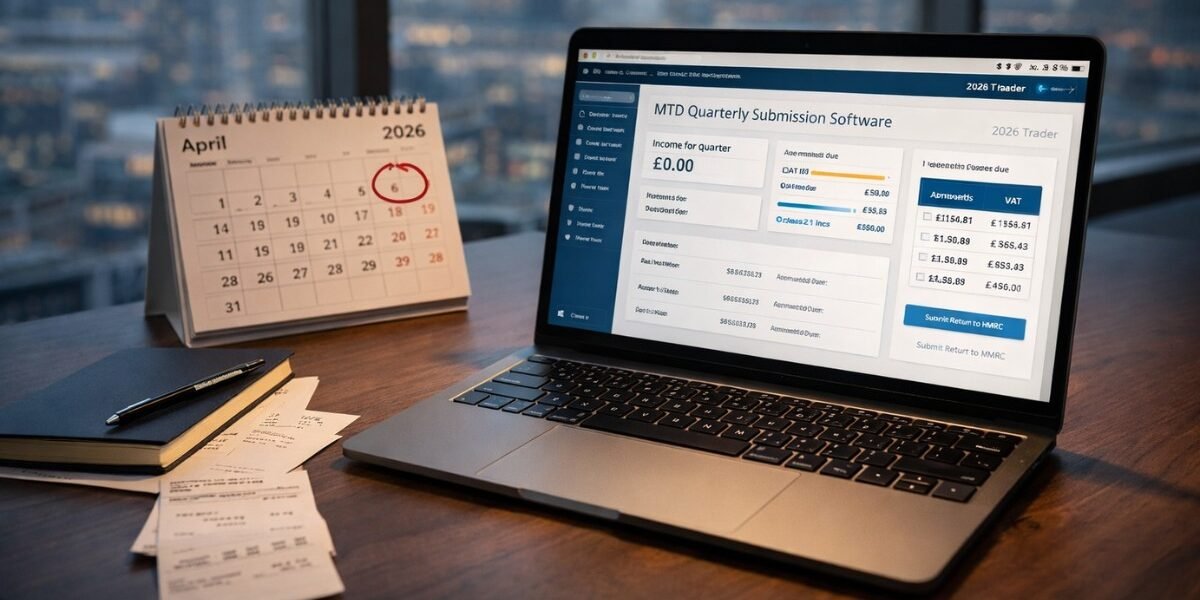
UK sole trader desk showing MTD for sole traders UK 2026 quarterly submission software

MTD for sole traders UK 2026 is now less than two weeks from going live. From 6 April, HMRC will require hundreds of thousands of self-employed individuals to keep digital records and submit quarterly updates using compatible software. If your gross qualifying income exceeds £50,000, this affects you — ready or not.

What MTD for Sole Traders UK 2026 Actually Changes

Making Tax Digital for Income Tax Self-Assessment replaces the old annual self-assessment process with something fundamentally different: continuous digital reporting. Instead of pulling everything together once a year and filing by 31 January, you’ll now need to:
Keep digital records of all business income and expenses throughout the year using HMRC-recognised software.
Submit quarterly updates to HMRC — summary figures showing income received and expenses incurred during each period.
File a final declaration after the tax year ends, replacing the traditional self-assessment return.
This isn’t a minor tweak to your admin. It changes when you report, how you report, and how often. The quarterly updates are what HMRC calls “light touch” — summary figures, not full tax computations — but producing them accurately requires up-to-date digital records running in the background all year.
The penalty regime is changing too. HMRC’s introducing a points-based system for late submissions. Miss a quarterly update and you pick up a penalty point. Hit four points within two years and a £200 financial penalty kicks in. Late payments carry separate, escalating penalties based on how overdue the amount is.
One concession for year one: HMRC has confirmed that penalty points for late quarterly updates won’t result in financial penalties during 2026/27. But late annual returns and late payments? Those still bite from day one.

Who’s Affected — and the Gross Income Trap

The first wave captures self-employed individuals and landlords with combined gross qualifying income above £50,000. That threshold drops to £30,000 from April 2027 and to £20,000 from April 2028.
Here’s the detail most people miss: the threshold is based on gross income, not profit. Invoice £60,000 a year but spend £25,000 on materials? Your taxable profit might be £35,000 — but HMRC sees your gross figure of £60,000. You’re in scope.
Multiple income sources get combined. A freelance designer earning £30,000 from self-employment and £25,000 from a rental property has a combined qualifying income of £55,000 — and must comply from April 2026. If you also hold rental property, how MTD applies if you also have rental income covers the landlord-specific obligations in detail.
HMRC estimates 864,000 sole traders and landlords will need to comply from April 2026. A further 1.6 million are expected to follow in subsequent phases.
One clarification: qualifying income includes gross receipts from self-employment and property only. PAYE salary, dividends, and pension income don’t count. HMRC will assess your eligibility based on the figures from your 2024/25 tax return.

The Four Things You Need to Do Now

If you’re in scope, here’s what needs to happen before 6 April 2026.

1. Sign Up for MTD

HMRC won’t auto-enrol you. You need to sign up yourself through the GOV.UK online service, or get your accountant to do it. Fail to register and you’re still legally required to comply — penalties apply regardless.

2. Choose HMRC-recognised Software

You can’t submit MTD updates using a spreadsheet on its own. You need software that’s formally recognised by HMRC for MTD for Income Tax. The major players are Xero, QuickBooks, Sage, FreeAgent, and SumUp — which is building a free MTD tool using Sage’s embedded accounting engine.
If you’re weighing up which platform suits your business, our Xero vs QuickBooks UK comparison covers the two most widely adopted options. For businesses already on Sage or thinking about switching, whether Sage or Xero is the better fit for your setup breaks down the payroll and compliance differences.
Bridging software exists if you’re determined to keep using spreadsheets, but it adds a manual layer and requires digital links between your records and HMRC’s systems. Most advisers recommend biting the bullet and moving to a single integrated platform.

3. Set Up Digital Record-Keeping

Your records need to be maintained digitally from the start of the 2026/27 tax year. That means recording every transaction — income in, expenses out — in your chosen software as it happens. Not retrospectively at quarter-end.
If you have multiple self-employment businesses, or you’re both self-employed and a landlord, you’ll need to submit separate quarterly updates for each source. A self-employed plumber who also rents out a property could end up filing eight quarterly updates per year, plus a single final declaration. That’s a significant admin burden if your systems aren’t ready.

4. Separate Your Business Finances

MTD works best when business income and expenses flow through a dedicated business account. If you’re still running personal and business transactions through the same account, now is the time to split them. Our ranked guide to UK business banking covers accounts with direct bank feed integrations that simplify MTD record-keeping considerably.

Deadlines and Key Dates for MTD for Sole Traders UK 2026

The quarterly update deadlines for the 2026/27 tax year are:
Quarter 1 (6 April – 5 July 2026): update due by 7 August 2026.
Quarter 2 (6 July – 5 October 2026): update due by 7 November 2026.
Quarter 3 (6 October – 5 January 2027): update due by 7 February 2027.
Quarter 4 (6 January – 5 April 2027): update due by 7 May 2027.
Your final declaration — the digital replacement for the self-assessment return — is due by 31 January 2028.
One thing that catches people out: you’ll still need to file a traditional self-assessment return for the 2025/26 tax year by 31 January 2027. MTD runs in parallel from April 2026. It doesn’t replace your existing obligations for the current tax year.

Common Mistakes to Avoid

Assuming profit determines eligibility. It doesn’t. Gross income is what matters. Even if your net profit is modest, a high turnover puts you in scope for MTD for sole traders UK 2026.
Waiting for HMRC to contact you. HMRC is writing to affected taxpayers, but the obligation applies whether or not you get a letter. The onus is entirely on you to register.
Confusing MTD for VAT with MTD for Income Tax. Already submitting VAT returns digitally? Good — but that doesn’t mean you’re covered for Income Tax. They’re separate obligations with separate software requirements. Don’t assume one covers the other.
Underestimating the quarterly rhythm. Four submissions per year per income source is a fundamentally different way of working. Build the habit early — even during the first-year soft landing — and you’ll avoid errors compounding across quarters.
Using non-recognised software. Your software must appear on HMRC’s list of recognised MTD for Income Tax products. Not every accounting tool has been approved yet. Check before you commit to anything.

Where to Get Help

HMRC has published a dedicated sign-up page for MTD for Income Tax on GOV.UK, along with an agent toolkit for accountants supporting clients through the transition. The guidance covers eligibility checks, approved software lists, and exemption applications.
You may be eligible for an exemption if it’s unreasonable or impractical for you to use digital tools — for example, due to age, disability, or remote location. Applications are handled through HMRC’s online portal.
If your tax affairs are complex — multiple businesses, overseas income, partnership structures — get professional advice. MTD for sole traders UK 2026 changes the mechanics of how you report, not the underlying tax rules. But the shift to quarterly digital reporting has a way of exposing gaps in record-keeping that previously stayed hidden until the January scramble.
This article is for informational purposes only and does not constitute tax advice. For guidance specific to your circumstances, consult a qualified tax adviser or accountant.

FAQ

Do I need MTD if I earn under £50,000?

Not from April 2026. The threshold drops to £30,000 in April 2027 and £20,000 in April 2028. If your gross qualifying income is below £50,000 for the 2024/25 tax year, you’re not required to comply yet — but you can sign up voluntarily.

Can I still use spreadsheets?

Technically yes, but only with bridging software that creates a digital link to HMRC. Standalone spreadsheets without bridging aren’t compliant. Most advisers recommend moving to integrated MTD software instead.

What happens if I miss a quarterly update?

During 2026/27, HMRC will record penalty points but won’t apply financial penalties for late quarterly updates. From 2027/28 onwards, hitting four late submission points within two years triggers a £200 penalty. Late payment penalties apply from day one regardless.

Does MTD apply to partnerships?

Not yet. HMRC has indicated partnerships and LLPs will be included in a future phase, but no date’s been confirmed. Individual partners may still be caught if they have qualifying income from sole trading or property in their own right.


If you’re comparing MTD-compatible accounting software, our Xero vs QuickBooks UK breakdown covers what matters most for UK sole traders.


MTD for Sole Traders UK 2026: What You Must Do Before 6 April

MTD for sole traders UK 2026 is now less than two weeks from going live. From 6 April, HMRC will require hundreds of thousands of self-employed individuals to keep digital records and submit quarterly updates using compatible software. If your gross qualifying income exceeds £50,000, this affects you — ready or not.

What MTD for Sole Traders UK 2026 Actually Changes

Making Tax Digital for Income Tax Self-Assessment replaces the old annual self-assessment process with something fundamentally different: continuous digital reporting. Instead of pulling everything together once a year and filing by 31 January, you’ll now need to:
Keep digital records of all business income and expenses throughout the year using HMRC-recognised software.
Submit quarterly updates to HMRC — summary figures showing income received and expenses incurred during each period.
File a final declaration after the tax year ends, replacing the traditional self-assessment return.
This isn’t a minor tweak to your admin. It changes when you report, how you report, and how often. The quarterly updates are what HMRC calls “light touch” — summary figures, not full tax computations — but producing them accurately requires up-to-date digital records running in the background all year.
The penalty regime is changing too. HMRC’s introducing a points-based system for late submissions. Miss a quarterly update and you pick up a penalty point. Hit four points within two years and a £200 financial penalty kicks in. Late payments carry separate, escalating penalties based on how overdue the amount is.
One concession for year one: HMRC has confirmed that penalty points for late quarterly updates won’t result in financial penalties during 2026/27. But late annual returns and late payments? Those still bite from day one.

Who’s Affected — and the Gross Income Trap

The first wave captures self-employed individuals and landlords with combined gross qualifying income above £50,000. That threshold drops to £30,000 from April 2027 and to £20,000 from April 2028.
Here’s the detail most people miss: the threshold is based on gross income, not profit. Invoice £60,000 a year but spend £25,000 on materials? Your taxable profit might be £35,000 — but HMRC sees your gross figure of £60,000. You’re in scope.
Multiple income sources get combined. A freelance designer earning £30,000 from self-employment and £25,000 from a rental property has a combined qualifying income of £55,000 — and must comply from April 2026. If you also hold rental property, how MTD applies if you also have rental income covers the landlord-specific obligations in detail.
HMRC estimates 864,000 sole traders and landlords will need to comply from April 2026. A further 1.6 million are expected to follow in subsequent phases.
One clarification: qualifying income includes gross receipts from self-employment and property only. PAYE salary, dividends, and pension income don’t count. HMRC will assess your eligibility based on the figures from your 2024/25 tax return.

The Four Things You Need to Do Now

If you’re in scope, here’s what needs to happen before 6 April 2026.

1. Sign Up for MTD

HMRC won’t auto-enrol you. You need to sign up yourself through the GOV.UK online service, or get your accountant to do it. Fail to register and you’re still legally required to comply — penalties apply regardless.

2. Choose HMRC-recognised Software

You can’t submit MTD updates using a spreadsheet on its own. You need software that’s formally recognised by HMRC for MTD for Income Tax. The major players are Xero, QuickBooks, Sage, FreeAgent, and SumUp — which is building a free MTD tool using Sage’s embedded accounting engine.
If you’re weighing up which platform suits your business, our Xero vs QuickBooks UK comparison covers the two most widely adopted options. For businesses already on Sage or thinking about switching, whether Sage or Xero is the better fit for your setup breaks down the payroll and compliance differences.
Bridging software exists if you’re determined to keep using spreadsheets, but it adds a manual layer and requires digital links between your records and HMRC’s systems. Most advisers recommend biting the bullet and moving to a single integrated platform.

3. Set Up Digital Record-Keeping

Your records need to be maintained digitally from the start of the 2026/27 tax year. That means recording every transaction — income in, expenses out — in your chosen software as it happens. Not retrospectively at quarter-end.
If you have multiple self-employment businesses, or you’re both self-employed and a landlord, you’ll need to submit separate quarterly updates for each source. A self-employed plumber who also rents out a property could end up filing eight quarterly updates per year, plus a single final declaration. That’s a significant admin burden if your systems aren’t ready.

4. Separate Your Business Finances

MTD works best when business income and expenses flow through a dedicated business account. If you’re still running personal and business transactions through the same account, now is the time to split them. Our ranked guide to UK business banking covers accounts with direct bank feed integrations that simplify MTD record-keeping considerably.

Deadlines and Key Dates for MTD for Sole Traders UK 2026

The quarterly update deadlines for the 2026/27 tax year are:
Quarter 1 (6 April – 5 July 2026): update due by 7 August 2026.
Quarter 2 (6 July – 5 October 2026): update due by 7 November 2026.
Quarter 3 (6 October – 5 January 2027): update due by 7 February 2027.
Quarter 4 (6 January – 5 April 2027): update due by 7 May 2027.
Your final declaration — the digital replacement for the self-assessment return — is due by 31 January 2028.
One thing that catches people out: you’ll still need to file a traditional self-assessment return for the 2025/26 tax year by 31 January 2027. MTD runs in parallel from April 2026. It doesn’t replace your existing obligations for the current tax year.

Common Mistakes to Avoid

Assuming profit determines eligibility. It doesn’t. Gross income is what matters. Even if your net profit is modest, a high turnover puts you in scope for MTD for sole traders UK 2026.
Waiting for HMRC to contact you. HMRC is writing to affected taxpayers, but the obligation applies whether or not you get a letter. The onus is entirely on you to register.
Confusing MTD for VAT with MTD for Income Tax. Already submitting VAT returns digitally? Good — but that doesn’t mean you’re covered for Income Tax. They’re separate obligations with separate software requirements. Don’t assume one covers the other.
Underestimating the quarterly rhythm. Four submissions per year per income source is a fundamentally different way of working. Build the habit early — even during the first-year soft landing — and you’ll avoid errors compounding across quarters.
Using non-recognised software. Your software must appear on HMRC’s list of recognised MTD for Income Tax products. Not every accounting tool has been approved yet. Check before you commit to anything.

Where to Get Help

HMRC has published a dedicated sign-up page for MTD for Income Tax on GOV.UK, along with an agent toolkit for accountants supporting clients through the transition. The guidance covers eligibility checks, approved software lists, and exemption applications.
You may be eligible for an exemption if it’s unreasonable or impractical for you to use digital tools — for example, due to age, disability, or remote location. Applications are handled through HMRC’s online portal.
If your tax affairs are complex — multiple businesses, overseas income, partnership structures — get professional advice. MTD for sole traders UK 2026 changes the mechanics of how you report, not the underlying tax rules. But the shift to quarterly digital reporting has a way of exposing gaps in record-keeping that previously stayed hidden until the January scramble.
This article is for informational purposes only and does not constitute tax advice. For guidance specific to your circumstances, consult a qualified tax adviser or accountant.

FAQ

Do I need MTD if I earn under £50,000?

Not from April 2026. The threshold drops to £30,000 in April 2027 and £20,000 in April 2028. If your gross qualifying income is below £50,000 for the 2024/25 tax year, you’re not required to comply yet — but you can sign up voluntarily.

Can I still use spreadsheets?

Technically yes, but only with bridging software that creates a digital link to HMRC. Standalone spreadsheets without bridging aren’t compliant. Most advisers recommend moving to integrated MTD software instead.

What happens if I miss a quarterly update?

During 2026/27, HMRC will record penalty points but won’t apply financial penalties for late quarterly updates. From 2027/28 onwards, hitting four late submission points within two years triggers a £200 penalty. Late payment penalties apply from day one regardless.

Does MTD apply to partnerships?

Not yet. HMRC has indicated partnerships and LLPs will be included in a future phase, but no date’s been confirmed. Individual partners may still be caught if they have qualifying income from sole trading or property in their own right.


If you’re comparing MTD-compatible accounting software, our Xero vs QuickBooks UK breakdown covers what matters most for UK sole traders.

Don't miss The Brief

Join UK tech decision-makers getting our weekly intelligence briefing. Low-noise, high-signal.