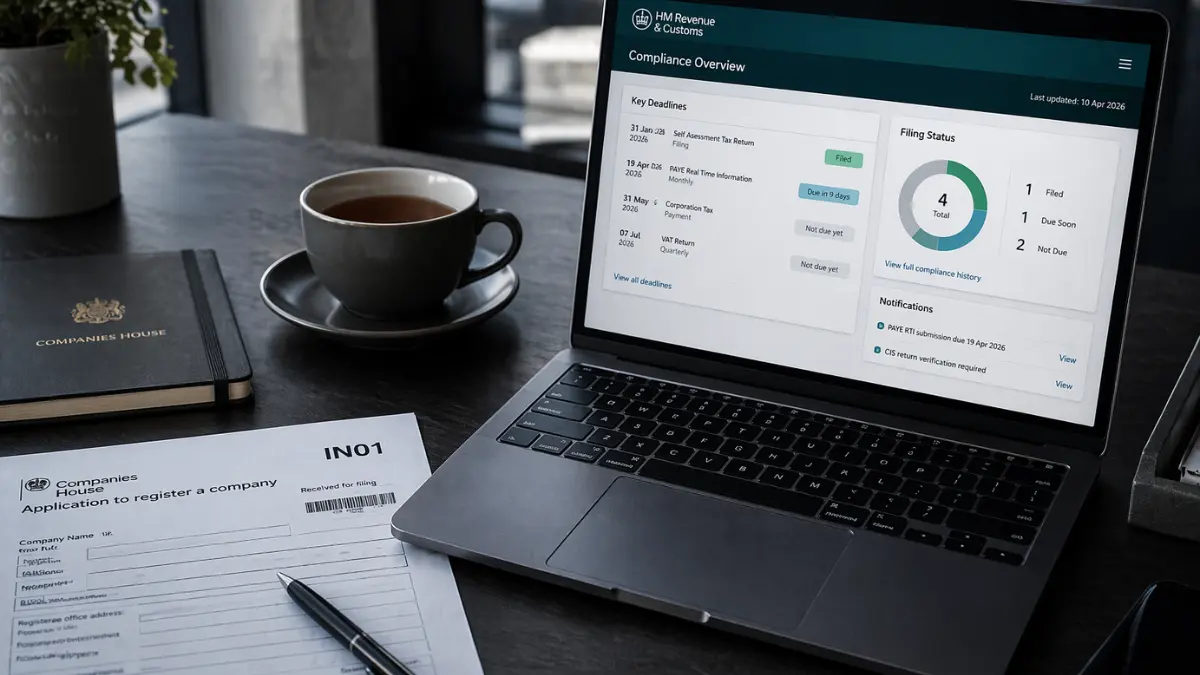
A limited company’s tax filing, its annual accounts and a director’s personal Income Tax obligations are different. Closing a joint filing portal did not merge them into one Making Tax Digital scheme.
The joint filing service closed
The joint HMRC/Companies House online service closed on 31 March 2026. Companies House explains that annual accounts can still be filed through appropriate third-party software, its web services or paper routes. HMRC Company Tax Returns normally require commercial software. See the official closure announcement.
HMRC’s current Corporation Tax software guidance also identifies paper-return exceptions for a reasonable excuse or filing in Welsh. Therefore “commercial software is mandatory for every return and all annual accounts without exception” was incorrect.
The supplier list can cover software producing one or more components of a return. An accounting brand’s presence does not prove that every subscription includes CT600 filing, computations and iXBRL accounts. Confirm the exact product, required supplementary pages, access and filing responsibility.
Corporation Tax and MTD are separate
HMRC’s 2025 Transformation Roadmap says it does not intend to introduce MTD for Corporation Tax. Other company-tax modernisation work does not make the personal Income Tax rollout a company-tax requirement.
A company may have MTD for VAT obligations separately. “No MTD for Corporation Tax” should not be shortened to “limited companies have no MTD obligations”. Check the taxes and registration relevant to that company.
Ordinary Corporation Tax payment and filing dates are different. Payment is generally due nine months and one day after the accounting period, but large and very large companies can pay by instalments. Check HMRC’s payment rules rather than applying one date universally.
A director can be personally in scope
Salary and dividends do not count as MTD qualifying income. Qualifying personal self-employment and property income can count. For the April 2026 phase, check whether the relevant 2024/25 total exceeded £50,000 and whether an exemption applies. Later phases use different income years and thresholds. Use HMRC’s eligibility tool.
Illustration: £55,000 of qualifying personal rental income in 2024/25 can put an otherwise eligible director in the April 2026 group even where the company files its own returns separately. A £55,000 company turnover figure does not establish that director’s personal MTD position.
Likewise, £42,000 qualifying income in 2025/26 can be relevant to the £30,000 threshold from April 2027. The income year matters; a current monthly rent figure alone is not the test. Take care with other income and exemptions.
What to confirm with the accountant
ObvioTech checklist: ask for a short responsibility map rather than a blanket assurance that “the software handles tax”.
- Identify who files the company return and accounts, which product is used and which components it supplies.
- Record company payment, return and accounts deadlines separately.
- Assess each director’s personal income without mixing it with company turnover.
- If personal MTD applies, confirm registration, income-source support, quarterly updates and annual-return capability.
- Retain submission confirmations and access-recovery arrangements.
These are suggested administrative checks, not a claim that any named vendor has been tested or that an accountant’s involvement guarantees compliance. General information only: obtain qualified advice about the company and personal circumstances.