1. Executive Context: The End of “Policy-Neutral” Investing
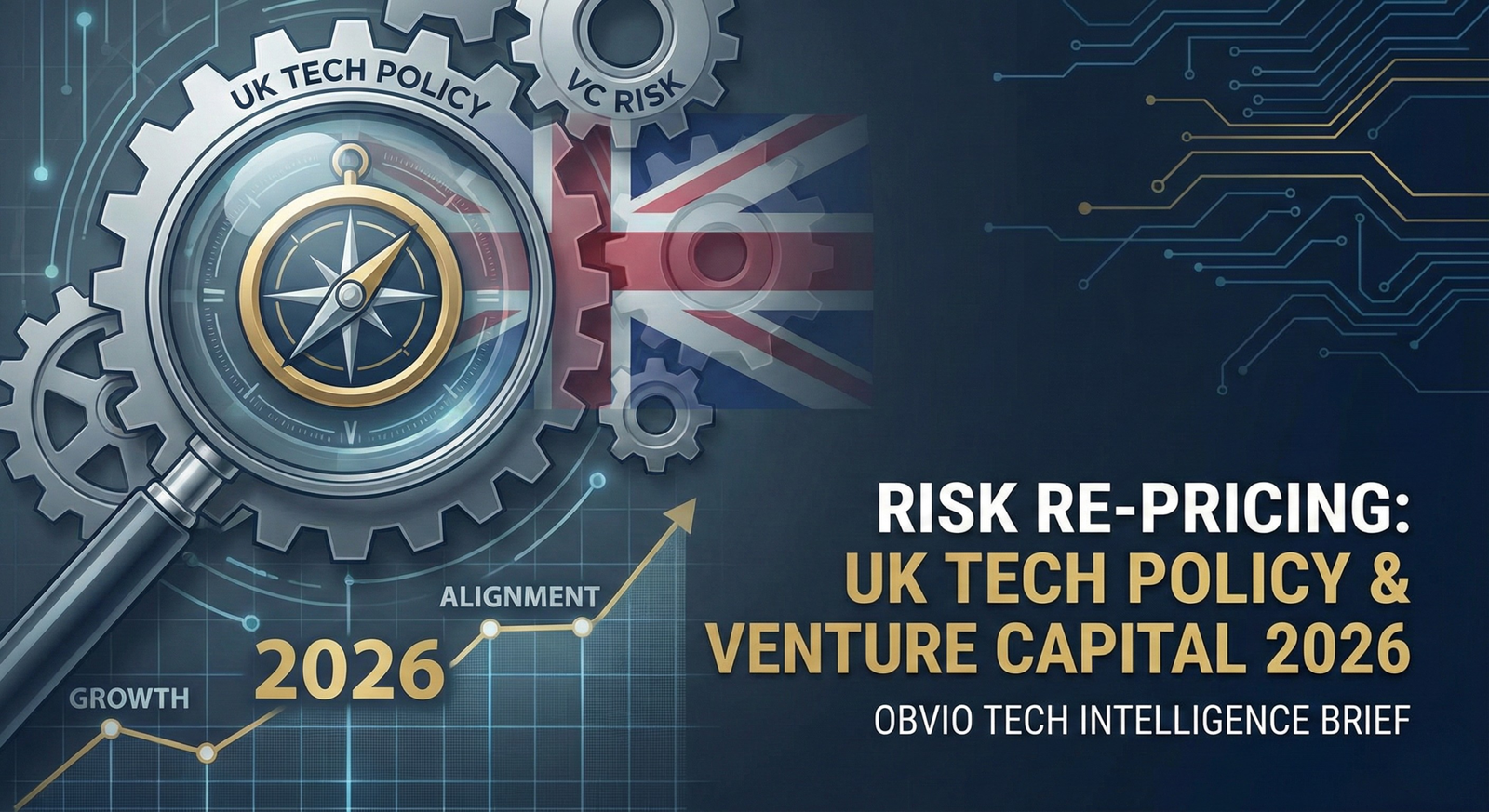
In 2026, the era of policy-neutral venture capital in the United Kingdom has definitively closed. For the last decade, investors operated under the assumption that regulation was a secondary consideration—a compliance hurdle to be cleared after product-market fit was established. Today, UK tech policy venture capital 2026 dynamics suggest that regulation is no longer just a hurdle; it is a primary determinant of asset viability, valuation, and exit liquidity.
The convergence of national security concerns, sovereign capability requirements, and the maturation of the post-Brexit regulatory framework has created a new operational reality. The UK government is no longer merely a regulator of technology markets; it is an active market participant, steering capital flows toward “strategic advantage” sectors while simultaneously erecting higher barriers for technologies deemed dual-use or critical national infrastructure.
For institutional investors, General Partners (GPs), and Limited Partners (LPs), this shifts the risk calculus. The definition of “venture risk” has expanded beyond execution and market adoption to include “policy alignment.” Capital deployment strategies that ignore the specific directives of the Department for Science, Innovation and Technology (DSIT) or the restrictions of the National Security and Investment Act (NSIA) are facing increased friction. Conversely, funds that align with the state’s industrial strategy are finding liquidity pathways smoothed by public-private co-investment mechanisms.
This intelligence brief analyzes how the UK’s regulatory architecture is quietly forcing a repricing of risk across the venture ecosystem, moving from a laissez-faire approach to a model of directed strategic capital.
2. Regulatory Signals Investors Are Reading
The signal-to-noise ratio in UK policy can be poor. However, sophisticated investors are looking past the headlines and focusing on the structural mechanisms being built by the Department for Science, Innovation and Technology. The rhetoric of “science superpower” has transitioned into the bureaucratic reality of framework implementation.
The Shift from Broad Support to Targeted Intervention
The Science and Technology Framework laid the groundwork for the current environment. In 2026, we are seeing the mid-term consequences of this strategy. The government has moved away from broad, horizontal support for “tech” generally, and toward vertical intervention in five critical technologies: AI, quantum, engineering biology, semiconductors, and future telecoms.
For VCs, this creates a two-tier market:
- Strategic Verticals: Sectors where UK technology policy actively de-risks investment through grants, procurement guarantees, and sandbox environments.
- General Tech: Sectors where regulatory friction is increasing without the counterbalance of state support (e.g., consumer social, pure-play marketplaces).
The Treasury’s “Productive Finance” Mandate
The Treasury’s ongoing push to unlock pension funds for private market assets—initiated by the Mansion House reforms—is finally showing material impact in 2026. However, this capital is not neutral. It comes with a mandate for “productive finance” that favors UK-domiciled assets and infrastructure-heavy projects.
Investors must recognize that British venture capital regulation is increasingly designed to trap value within the UK. The implicit signal is that capital flight—where UK R&D is acquired by non-UK entities before commercial scaling—will be met with regulatory resistance. This changes the exit analysis for early-stage investors who previously relied on rapid US acquisitions.
3. Capital Friction: Where Policy Slows or Redirects VC
The intersection of policy and capital is generating specific points of friction. These bottlenecks are not accidental; they are features of a system prioritizing sovereignty over pure velocity.
The Compute Infrastructure Bottleneck
While software remains scalable, the underlying infrastructure required to run advanced models is becoming a matter of national policy. The government’s tightening grip on data sovereignty and compute access creates a divergence in how capital is treated. Investors are realizing that software innovation without guaranteed infrastructure access is a stranded asset.
We have previously analysed how this oversight impacts the market. The industry focus has often been misplaced on intangible innovation rather than the physical rails it runs on. For a deeper understanding of this imbalance, see our analysis on the UK’s strategic tech blind spot and why compute infrastructure matters more than innovation.
The NSIA as a Due Diligence Gate
The National Security and Investment Act (NSIA) has matured into the single most significant policy risk for deep tech exits. In 2026, the scope of “national security” has effectively widened to include economic security.
VCs are finding that:
- Deal timelines are extending: Mandatory notifications for sensitive sectors are adding 3–6 months to deal cycles.
- Cap table composition matters: The source of LP capital is under scrutiny. Funds with significant exposure to geopolitical rivals are finding themselves excluded from rounds involving dual-use technologies.
- Exit blockages: Several high-profile blocked acquisitions in 2024 and 2025 have chilled the appetite for M&A in the semiconductor and defense-tech spaces.
Public-Private Capital Alignment
The British Business Bank has become the anchor investor of necessity for many deep tech funds. This public private investment UK dynamic creates a stabilizing floor but also imposes covenants on how funds operate. We are seeing a trend where private capital is hesitant to enter Series B+ rounds in deep tech without a parallel commitment from a government-backed vehicle to share the long-tail risk.
4. Case Signals from AI, Quantum, and Infrastructure
To understand the practical application of these policies, one must look at sectoral case studies where the friction is most acute.
Quantum: The Sovereignty Trap
Quantum technologies represent the apex of policy-driven investment risk. The UK government views quantum not just as an industry, but as a sovereign capability. Consequently, while funding is abundant, the “freedom of movement” for that IP is restricted.
Investors are facing a paradox: the sector offers massive potential returns, but the path to realizing those returns is constrained by export controls and national security caveats. This creates a unique risk profile where a company can be technically successful but commercially trapped. We explore this specific tension in our report on sovereignty vs scale and the paradox of the UK’s quantum leap, which details how localization requirements are impacting valuation multiples.
AI: The Compliance Cliff
In 2026, the divergence between UK and EU AI regulation has become a tangible operational cost. While the UK initially positioned itself as “pro-innovation” with a lighter touch than the EU AI Act, the reality for enterprise adoption is complex. British startups selling into the continent must adhere to EU standards, effectively importing Brussels’ regulation into London.
However, domestic compliance is no longer negligible. As AI moves from generative experiments to core business logic, the regulatory burden on “critical” AI applications has spiked. This is creating a compliance gap that VCs must price into their seed rounds. For a detailed breakdown of this regulatory mismatch, refer to our briefing on the UK-EU AI compliance gap in 2026.
Fintech and Banking: The ROI Reality Check
The financial services sector, historically the engine of UK VC, is undergoing a rigorous efficiency audit. The deployment of Generative AI in banking is being watched closely by regulators (FCA/PRA) concerned with systemic risk and hallucinations.
The policy stance here is “cautious adoption,” which has slowed the deployment of capital into B2B fintech infrastructure. The hype cycles of 2023 have been replaced by strict ROI demands. Investors are prioritizing operational resilience over novelty. Our analysis of the real ROI of generative AI in British banking in 2026 highlights that regulatory drag is currently the primary factor reducing net yield on AI investments in this sector.
5. What Smart UK VCs Are Adapting To
In response to this environment, the most successful UK funds are altering their operational structures. The “move fast” ethos is being replaced by “move strategically.”
1. Policy Due Diligence (PDD)
Top-tier firms are now conducting formal Policy Due Diligence alongside commercial and technical diligence. This involves:
- Assessing the “dual-use” risk of a technology.
- Mapping the startup’s supply chain against geopolitical friction points.
- Evaluating the “sovereign stickiness” of the IP (i.e., can it be easily moved to the US, or will the government block it?).
2. The Operational Pivot
VCs are demanding that portfolio companies move beyond theoretical capabilities to proven operational utility much earlier in the lifecycle. The tolerance for prolonged R&D phases without clear commercial traction has evaporated, largely due to the drying up of “tourist capital” that previously supported these phases.
There is a distinct shift toward funding companies that can integrate into existing industrial workflows rather than those attempting to disrupt them entirely. This is particularly true in AI, where the focus has shifted to implementation. For insight into where this capital is actually going, see our study on how UK companies actually use AI operations in 2026.
3. Structural alignment with “National Missions”
Smart capital is aligning its thesis with the government’s stated “missions.” If a startup’s value proposition can be framed as solving a critical public sector challenge (NHS efficiency, energy security, border control), it gains access to non-dilutive funding and procurement channels that purely commercial ventures cannot touch. UK innovation funding is increasingly conditional on this mission alignment.
6. UK Tech Policy Venture Capital 2026 Outlook (2026–2028)
Looking ahead, the policy landscape suggests a tightening of fiscal accountability and a narrowing of focus.
The NAO Audit Loom
The National Audit Office (NAO) is expected to increase its scrutiny of government innovation spending. Following the rapid deployment of funds in 2024/2025, the inevitable audit cycle will likely reveal inefficiencies. This presents a risk for start-ups reliant on government grants; we anticipate a “clawback” culture or at least a significant raising of the bar for future grant eligibility.
The Scale-Up Gap Persists
Despite UK scale-up policy initiatives, the gap between Series B and IPO remains the UK’s structural weakness. The London Stock Exchange (LSE) reforms have made listing easier, but they haven’t solved the liquidity problem. The risk for VCs in 2026–2028 is that the UK government may implement more aggressive “stick” measures to force UK pension funds to buy UK equities, potentially distorting valuations.
Divergence from US Standards
As the US pursues a hard-decoupling strategy from competitor nations, the UK’s attempt to walk a middle path will become harder to sustain. UK VCs may be forced to choose between taking US capital (and accepting US export control restrictions) or staying within a UK/EU sovereign bubble. This bifurcation will split the market into “Atlanticist” startups and “Sovereign” startups.
7. Strategic Takeaway for Investors & Founders
UK tech policy venture capital 2026 dynamics mean regulation is now a pricing factor: In the UK, regulation directly affects valuation, exit routes, and time-to-liquidity.
For Founders:
Do not build in a regulatory vacuum. If you are in deep tech, your roadmap must account for NSIA compliance and export controls from Day 1. Align your product narrative with the government’s Industrial Strategy to unlock UK innovation funding, but be wary of becoming dependent on public procurement cycles which are notoriously slow.
For Investors:
The alpha in 2026 lies in regulatory arbitrage—identifying companies that have mastered the “compliance moat.” Regulatory complexity is a barrier to entry that protects incumbents. Fund managers should prioritize assets that have deeply integrated with UK policy frameworks, as these companies will be insulated from the volatility of the broader market.
The “quiet reshaping” of risk is complete. The government is now the silent partner on the cap table. The question for the rest of 2026 is not whether to engage with policy, but how to leverage it for competitive advantage.
Reader’s Take (Policy Intelligence Summary)
Capital flows are engineered, not free-market: Public–private funding structures increasingly reward sovereignty-aligned outcomes, even when innovation is incremental rather than disruptive.
The UK is a distinct asset class: Treating the UK as a smaller version of Silicon Valley leads to mispriced risk. It is a policy-shaped, state-influenced venture market where strategy consistently outperforms speed.
Policy is now a valuation input: In UK tech investing, regulation is no longer a secondary risk; it directly determines valuation, exit optionality, and time-to-liquidity.
Alignment outperforms acceleration: Founders and funds aligned with UK strategic priorities face faster regulatory clearance and improved access to capital—raw growth alone is no longer sufficient.
Compliance is a defensible moat: NSIA readiness, sector-specific regulatory mastery, and public-sector procurement literacy have become competitive advantages, not operational overhead.
“For a detailed breakdown of the mechanics, qualifying conditions, and pre-April actions, see our full analysis of the April 2026 carried interest reform.”