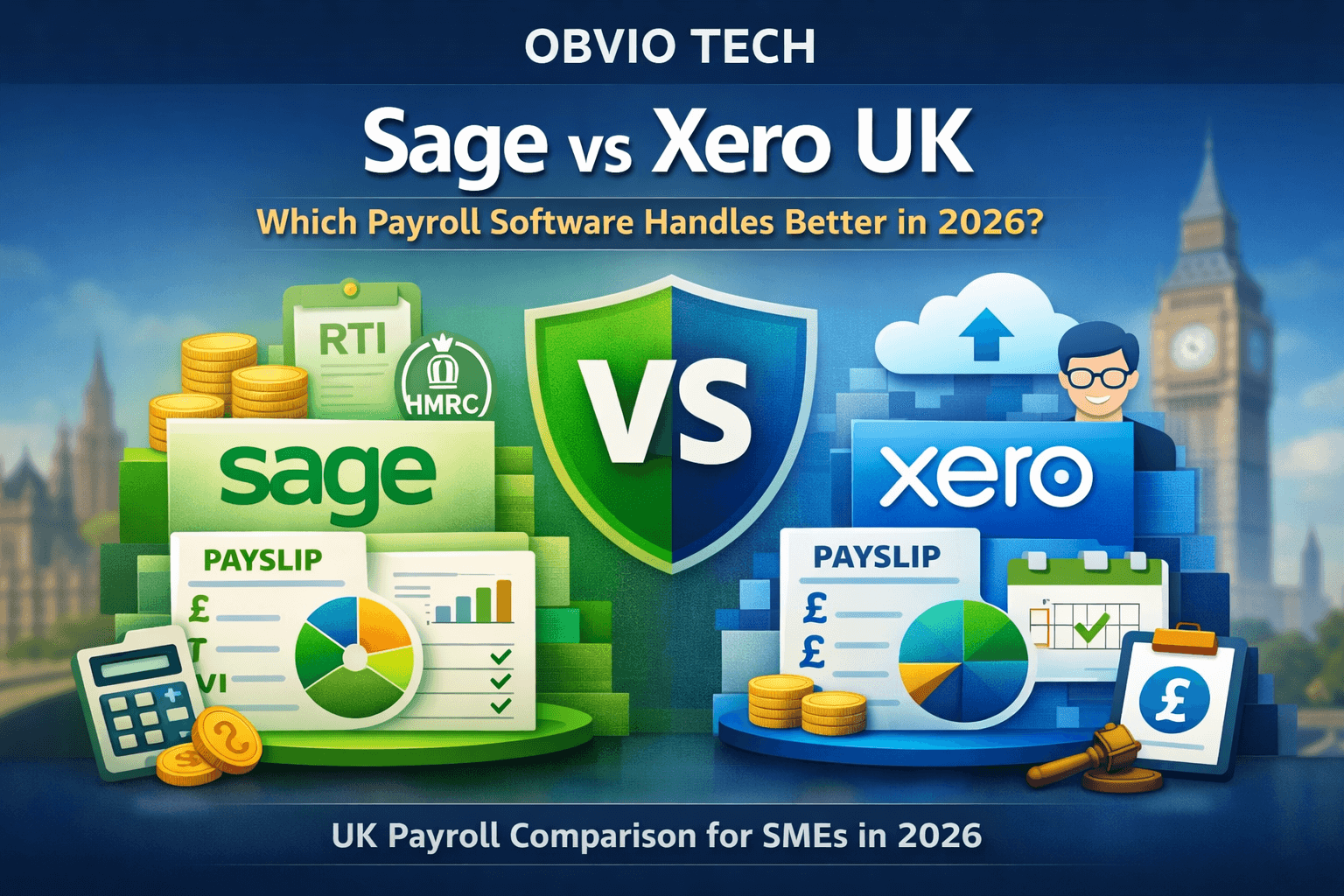
Sage vs Xero UK – Payroll is one of the most regulated, time-sensitive, and risk-prone responsibilities for UK businesses. Real Time Information (RTI) submissions, PAYE, National Insurance, pensions, and statutory payments leave little room for error. Even small mistakes can result in HMRC penalties or employee disputes.
This is why, in 2026, the comparison between Sage and Xero is especially important for UK SMEs.
Both platforms are HMRC-recognised and widely trusted by accountants. However, they are built with very different payroll philosophies.
This article compares Sage vs Xero strictly from a UK payroll perspective, helping you choose the platform that best matches how your business operates.
Quick Verdict for UK Employers
If you need a fast answer:
- Choose Sage if payroll is a core operational function, you employ staff, and you want a UK-native, compliance-first payroll system.
- Choose Xero if payroll is secondary, you work closely with an accountant, and you prefer payroll to sit inside a modern cloud accounting platform.
Both are compliant. The difference lies in depth versus flexibility.
UK Payroll Compliance: HMRC, RTI, and PAYE
UK payroll must comply with Real Time Information (RTI) rules, meaning employee pay data must be submitted accurately to HMRC every time payroll is run.
Sage: Payroll-First Architecture
Sage has decades of experience in the UK payroll market, and its software reflects that heritage.
- Native RTI submissions to HMRC
- Advanced PAYE and National Insurance calculations
- Built-in handling for statutory payments (SSP, SMP, etc.)
- Deep pension auto-enrolment integration
- Designed primarily for employers running payroll in-house
For businesses where payroll accuracy and compliance are non-negotiable, Sage offers a strong sense of control and reliability.
Xero: Payroll as Part of a Broader Accounting System
Xero treats payroll as one component of a wider accounting ecosystem.
- HMRC-compliant payroll functionality
- RTI support included
- Pension auto-enrolment supported
- Clean, modern user interface
- Commonly managed by accountants rather than employers
Xero payroll works well for standard scenarios but often assumes accountant involvement, particularly as payroll complexity increases.
Day-to-Day Payroll Usability
Using Sage
- Payroll-focused dashboards
- Detailed employee records
- Clear payslip breakdowns
- Highly structured workflows
- Less emphasis on visual design, more on functionality
There is a learning curve, but once set up, Sage payroll is predictable and consistent, which many UK employers value.
Using Xero
- Modern, intuitive interface
- Faster onboarding for non-specialists
- Payroll integrated with accounting data
- Fewer steps for simple payroll runs
For founders managing payroll themselves, Xero often feels easier in the early stages.
Payroll Features Comparison (UK Focus)
| Feature | Sage | Xero |
|---|---|---|
| HMRC RTI submissions | Native | Supported |
| PAYE & National Insurance | Advanced | Standard |
| Pension auto-enrolment | Deep integration | Supported |
| Statutory payments | Strong | Available |
| Payroll reporting | Detailed | Basic to mid-level |
| Employer-managed payroll | Strong | Less common |
| Best suited for | Payroll-heavy SMEs | Accountant-managed SMEs |
Pricing and Payroll Add-Ons (UK Only)
UK pricing varies by plan and employee count. VAT extra.
Sage
- Payroll is usually included or tightly bundled
- Pricing scales clearly with employee numbers
- Designed for ongoing, in-house payroll use
- Less reliance on third-party add-ons
Xero
- Payroll availability depends on plan and setup
- Costs increase as employee numbers grow
- Often bundled via accountant packages
- Total cost varies by configuration
Key takeaway:
Xero may appear cheaper initially, but Sage often offers more predictable payroll costs as a business grows.
Accountant-Led vs Employer-Led Payroll
This distinction is crucial.
Sage
- Built for employers running payroll internally
- Accountants can support but are not required
- Strong controls for compliance-focused teams
Xero
- Optimised for accountant-led workflows
- Widely adopted by UK accounting firms
- Less common for employers to manage complex payroll independently
If your accountant handles payroll, Xero fits naturally.
If you want direct control, Sage is usually the stronger option.
Scalability as Your Team Grows
Sage Is Better Suited For:
- Businesses with employees from the outset
- Payroll-heavy operations
- Compliance-driven organisations
- In-house payroll management
Xero Is Better Suited For:
- Service-based businesses
- Agencies and consultancies
- Gradual team growth
- Accountant-managed finance setups
Pros and Cons (UK Payroll Lens)
Sage Pros
- Industry-leading UK payroll functionality
- Strong HMRC and RTI compliance
- Robust pension handling
- Long-standing UK reputation
Sage Cons
- Less modern interface
- Steeper learning curve
- Can be excessive for very small teams
Xero Pros
- Clean, modern design
- Excellent accountant ecosystem
- Payroll integrated with accounting
- Easier for non-technical founders
Xero Cons
- Payroll depth is more limited
- Add-ons can increase cost
- Less suitable for payroll-intensive businesses
Final Recommendation: Sage or Xero for UK Payroll?
Choose Sage if payroll is mission-critical, you employ staff, and you want maximum compliance confidence with in-house control.
Choose Xero if payroll is a supporting function, you rely on an accountant, and you prefer a modern, cloud-based accounting experience.
There is no universal “best” choice — only the best fit for your UK payroll model.
Editorial Note (Obvio Tech)
- Contractors and freelancers may prefer FreeAgent
- Micro-businesses may find Clear Books more suitable
- Construction businesses should also evaluate CIS-focused solutions