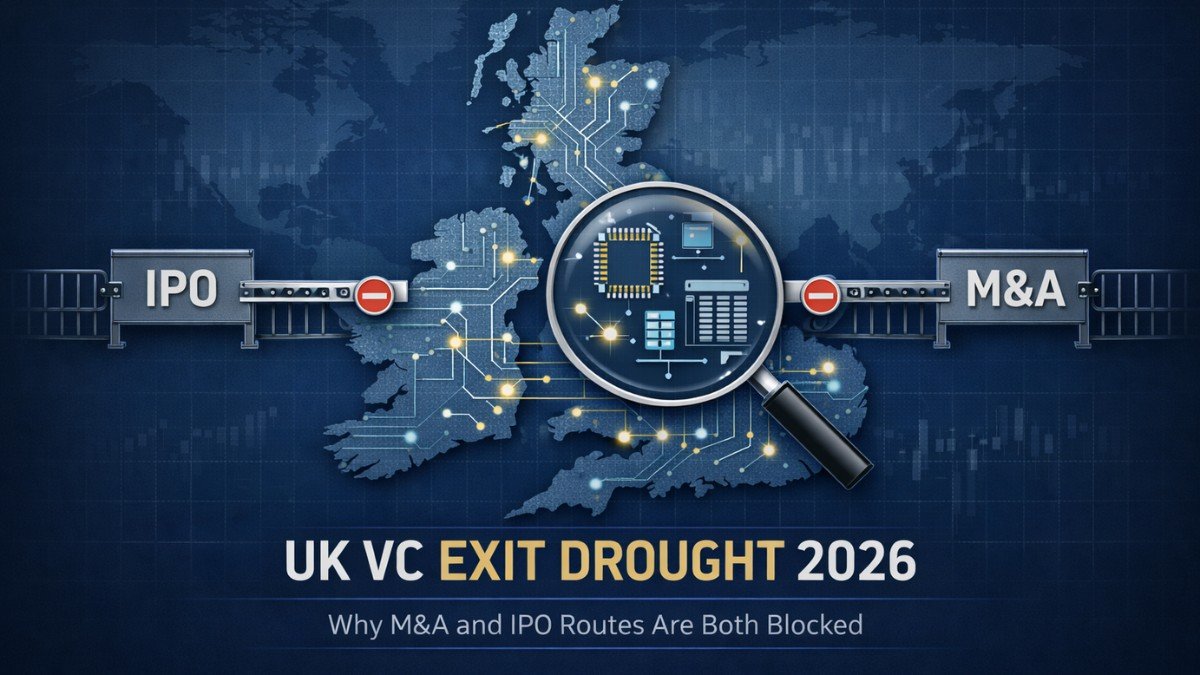
UK VC exits 2026 presents a stark picture: both exit routes have stalled, and the liquidity problem building underneath is one UK venture capital cannot trade its way out of. UK VC exits in 2026 face a structural double blockage that is proving resistant to the usual cyclical correctives. Deals are being done — early-stage cheques are still clearing, seed rounds are still closing — but the exit pipeline that converts paper returns into actual distributions has, for many funds, effectively frozen.
The two conventional routes out of a VC position are trade sales (M&A) and public listings (IPO). In 2026, both are functionally blocked in the UK. This is not a cyclical dip. The structural conditions that typically unlock exits — buyer confidence, valuation alignment, public market appetite, regulatory clarity — are all operating against UK-backed companies simultaneously. The result is a growing cohort of portfolio companies that are performing, but cannot be sold.
This piece examines why both exit routes are blocked, what that means for fund economics and LP distributions, and what the data from 2024–25 exit cycles tells us about when this resolves.
Table of Contents
UK VC exits in 2026: Why the IPO Window Simply Doesn’t Exist
The London Stock Exchange’s tech listing problem predates 2026, but it has worsened materially over the past eighteen months. The FTSE has not established itself as a credible destination for high-growth technology companies, and the gap between what UK-listed tech trades at and what comparable US-listed peers command has become a structural deterrent to listing domestically.
The valuation discount applied to UK-listed technology companies versus Nasdaq equivalents sits in a range that makes IPO unattractive as an exit mechanism for any founder or fund that has alternatives. For companies with genuine scale — £50m+ ARR, international revenues, institutional cap tables — the conversation almost always starts with New York, not London. The FCA’s listing reforms, while directionally correct, have not yet moved the needle on institutional appetite. Foreign institutional investors who drive the order books that make IPOs work have not demonstrably returned to UK listings in 2026.
Beyond valuation, the IPO process itself carries regulatory and reputational risk that has become harder to price. Infrastructure and compute constraints suppressing UK tech valuations — covered in detail in our analysis of the UK’s strategic compute infrastructure gap — mean that hardware-adjacent and infrastructure-dependent companies are entering any public market process with a structural discount already baked in. That discount compounds in a pre-IPO due diligence process and frequently kills momentum before a roadshow begins.
The practical outcome: UK VC-backed companies that would historically have targeted a 2025–26 IPO are either extending timelines to a notional 2027–28 window, pursuing dual-track processes that never close, or quietly removing IPO from their exit planning entirely.
Trade M&A Is Structurally Suppressed, Not Just Slow
If the IPO window is absent, trade M&A should theoretically absorb deal flow. It is not. The UK M&A market for technology assets is experiencing suppressed activity that goes beyond interest rate sensitivity and reflects three overlapping structural problems.
Strategic buyers are rationalising, not acquiring. The dominant behaviour among UK enterprise technology buyers in 2026 is consolidation of existing vendor relationships rather than bolt-on acquisition. As we documented in our analysis of enterprise buyers consolidating rather than acquiring in the UK enterprise AI vendor consolidation report, large organisations that might previously have filled capability gaps through acquisitions are instead doing so through contract renegotiations, platform expansions, and internal builds. This directly reduces the universe of willing trade buyers for VC-backed assets.
Cross-border M&A is constrained by the National Security and Investment Act. The NSIA, which came into force in January 2022, has introduced mandatory notification requirements across seventeen sensitive sectors. For any UK deep tech company — defence-adjacent AI, quantum, semiconductor IP, cybersecurity — the mandatory NSIA review process adds timeline uncertainty and closing risk to any transaction involving a non-UK acquirer. US strategic buyers in particular have become cautious about initiating processes where NSIA review creates a twelve-to-thirty week clearing period and an uncertain outcome. This is a direct suppression mechanism on the buyer side. Deep tech scale-up exits face a distinct set of structural barriers beyond standard M&A friction, as we explored in our piece on UK quantum technology’s sovereignty versus scale paradox.
Valuation expectations have not reset. Until sellers accept that 2021 marks are not 2026 clearing prices — or buyers start competing for scarce assets again — the pipeline does not move. Founders and funds carrying assets at 2021–22 valuations are unwilling to accept the step-down implied by 2025–26 strategic buyer pricing. Trade buyers, operating under their own cost pressure and board-level scrutiny on deal multiples, are not willing to pay marks that were set during a liquidity environment that no longer exists. This standoff is the primary reason UK M&A deal counts in the technology sector have remained depressed through Q4 2025 and into Q1 2026.
The Fund Economics Consequence: Life Extensions and LP Pressure
The blocked UK VC exit environment does not stay contained in portfolio management spreadsheets. It produces immediate, compounding consequences for fund economics.
UK venture funds raised in 2017–2020 are entering the phase of their lifecycle where distributions should be accelerating. Limited partners — pension funds, endowments, funds-of-funds, family offices — committed capital on the basis of a return timeline that is now stretching. Where exits have not materialised, GPs are working through a short menu of options: accept a discounted secondary sale, seek a fund life extension, or begin a continuation vehicle process. All three are increasingly common; none are cost-free.
Secondary market pricing for UK VC assets has softened. Specialist secondary buyers — and the market in the UK is thinner than in the US — are bidding at meaningful discounts to carrying value.
For an LP that has been patient through a ten-year fund lifecycle, accepting a secondary exit at 60–70p of carrying value — a range consistent with market intelligence from secondary intermediaries active in UK VC assets in Q4 2025–Q1 2026 — is not a tolerable outcome if the underlying portfolio company is still operating profitably. The result is that many secondaries are not clearing either.
Fund life extensions require LP consent. In a market where many LPs are themselves managing liquidity constraints — UK pension funds navigating LDI aftermath, endowments with their own distribution pressure — securing unanimous or majority LP approval for a three-year extension is increasingly contentious. GPs who built their relationships on a 10+2 model are now approaching LPs with a 10+4 or 10+5 ask and finding pushback.
This connects directly to the GP incentive layer. With carried interest tax reform arriving in April 2026 — moving carry treatment from capital gains to income tax as detailed in our UK carried interest tax reform analysis — the economics of holding assets through a prolonged exit drought are being recalculated in real time. GPs whose carry was previously treated at CGT rates have a materially different view of the cost of waiting. For some fund managers, the April 2026 tax change has introduced a new urgency to close whatever exits are achievable at current market pricing, even below prior expectations.
What This Means for UK Tech Policy and Venture Capital Risk
The exit drought is not a market failure in the technical sense — it is a logical consequence of policy and regulatory decisions layering over a period of valuation excess. UK tech policy is reshaping venture capital risk in ways that reach beyond the entry and hold phases, as documented in our UK tech policy and venture capital risk analysis, and the exit layer is now feeling that pressure most acutely.
Several policy levers exist that could structurally improve exit conditions, none of which have been activated decisively:
The FCA’s PISCES initiative — a private intermittent securities and capital exchange system — is designed to create a new liquidity layer for private company shares. In theory, this allows secondary trading of VC-backed company equity before a formal IPO, providing an intermediate exit mechanism. In practice, PISCES has not yet demonstrated meaningful volume, and the institutional buyers required to make secondary liquidity work have not committed to the venue. Whether PISCES becomes a genuine exit route for UK VC portfolios or remains a regulatory experiment is one of the most consequential open questions in UK VC policy for 2026–27.
British Business Bank lending programmes support entry and growth, but the BBB has limited tools to directly stimulate exit market activity. Its Patient Capital Review commitments increased the supply of long-term capital into UK VC, which partly contributed to the overhang problem now manifesting in the exit drought. More supply of long-duration capital into a market where exit routes are restricted produces portfolio congestion, not efficiency.
The NSIA review threshold and sector definitions have not been recalibrated since the Act’s introduction. A targeted review of which transaction types genuinely require mandatory notification — as opposed to applying broad sector definitions that sweep in acquisitions with no credible national security dimension — would reduce buyer hesitancy in cross-border M&A without compromising legitimate security screening. There is no indication DSIT is planning such a review in the near term.
The Resolution Timeline: Conditions, Not Calendar
Everyone in the cap table wants to know when the UK VC exit drought resolves. The answer is uncomfortable: it depends on conditions, not the calendar. Three conditions would need to change simultaneously or in quick succession to unlock both exit channels materially:
A sustained public market re-rating of UK technology companies would need to attract institutional order book participation at valuations competitive with US alternatives. This requires more than FCA listing reform — it requires fundamental institutional behaviour change among the global asset managers who allocate to IPOs. That change is not a 2026 event.
Strategic buyer confidence would need to return at volume. This is partly a macroeconomic function (lower cost of capital reducing acquisition financing friction) and partly a regulatory function (NSIA review risk becoming more predictable and faster-clearing). Neither condition is on a clear positive trajectory.
Founder and fund manager valuation expectations would need to reset to reflect actual 2025–26 market clearing prices rather than 2021–22 marks. This reset is happening slowly and unevenly. Funds with strong LP relationships and patient capital can defer it. Funds approaching end-of-life cannot.
The most likely UK VC exit scenario for 2026 is selective activity — a small number of assets in sectors with genuine scarcity value (defence tech, critical infrastructure software, specific AI infrastructure plays) attracting strategic buyers at reasonable multiples, while the broader cohort of SaaS-model, consumer-adjacent, and non-strategic assets continues to wait. For the VC funds caught in the middle of that distribution, the practical outcome is deeper into extension territory than any 2020–22 LP agreement anticipated.
UK venture capital built its 2020–22 vintage on assumptions about exit market function that no longer hold. The UK VC exit via IPO is structurally unavailable for the majority of assets. The UK VC exit via M&A is suppressed by buyer behaviour, regulatory friction, and valuation disconnects that are proving slow to clear. The fund economics consequence — life extensions, LP pressure, carry recalculation — is compounding in a tax environment that has just become materially more expensive for the GPs managing through it. The resolution is conditional on policy, market structure, and expectation resets that are not moving quickly enough to relieve the pressure building in the 2017–2022 vintage cohort. For UK founders, fund managers, and their LPs, the UK VC exit landscape in 2026 is a year of navigating constraint, not clearing it
For the regulatory backdrop shaping how capital is being deployed and priced across UK technology sectors, see our ongoing coverage in VC & Policy (UK).